
Wildfires ignited by electric grid infrastructure are no longer a California-only story.
A sweeping new draft report from the North American Electric Reliability Corporation (NERC), due to federal regulators on May 1, 2026, sets out the most detailed roadmap yet for how utilities across the U.S. and Canada must change the way they manage, monitor, and operate transmission lines in fire-prone areas.
For many utilities, the implications are significant: more lines to monitor, higher inspection standards, and a likely expansion of mandatory vegetation management rules that haven't changed in years.
Key takeaways
- NERC’s April 2026 draft report is a wildfire mitigation roadmap for utilities, outlining how the bulk power sector should reduce ignition risk and signaling likely future regulatory change.
- Its most important recommendation is to expand FAC-003 to include transmission lines rated 100–199 kV, bringing a much larger share of the grid under mandatory vegetation management requirements.
- The report also endorses geospatial AI and remote sensing tools for vegetation proximity modeling, risk forecasting, and continuous monitoring, making solutions like Treeline highly relevant for utilities preparing to manage this expanded scope.
What is NERC
The North American Electric Reliability Corporation (NERC), created on March 28, 2006, as the successor to the North American Electric Reliability Council (established June 1, 1968), provides regulatory oversight for the reliability and security of electricity supply across North America.
NERC was formed to promote the reliability and adequacy of bulk power transmission across the continent. It oversees six regional entities responsible for specific areas across the continental United States, Canada, and the northern portion of Baja California, Mexico, covering all interconnected power systems that serve nearly 400 million customers.
Through its governance structure, including the NERC Board’s role in approving and revising reliability standards and organizational procedures, NERC works to reduce risks to grid reliability and security, including wildfire-related threats.
In collaboration with government agencies such as FERC and DOE, NERC helps develop, support, and enforce reliability standards, while also leading monitoring, compliance, enforcement, and assessments of resource adequacy to help maintain a secure and reliable grid.
To support this mission, it has developed more than 80 mandatory reliability standards addressing various aspects of the reliable operation of the nation’s electric grid.
The Scale of the Problem
The numbers in the report are stark. Between 2017 and 2024, 1,425 transmission lines in NERC's jurisdiction in the Western Interconnection were impacted by wildfires. In 2024 alone, wildfire events affecting major transmission paths increased by 411% year-on-year.
At least 10% of all California wildfires between 2016 and 2020 were caused by electric grid infrastructure.
The critical vulnerability sits in a specific slice of the grid: transmission lines rated between 100 and 199 kV. These lines account for 86% of all vegetation-contact outages, yet they currently fall outside the scope of NERC's main vegetation management standard.
That gap is the central problem this report is built to fix.
What the NERC Wildfire Report Covers
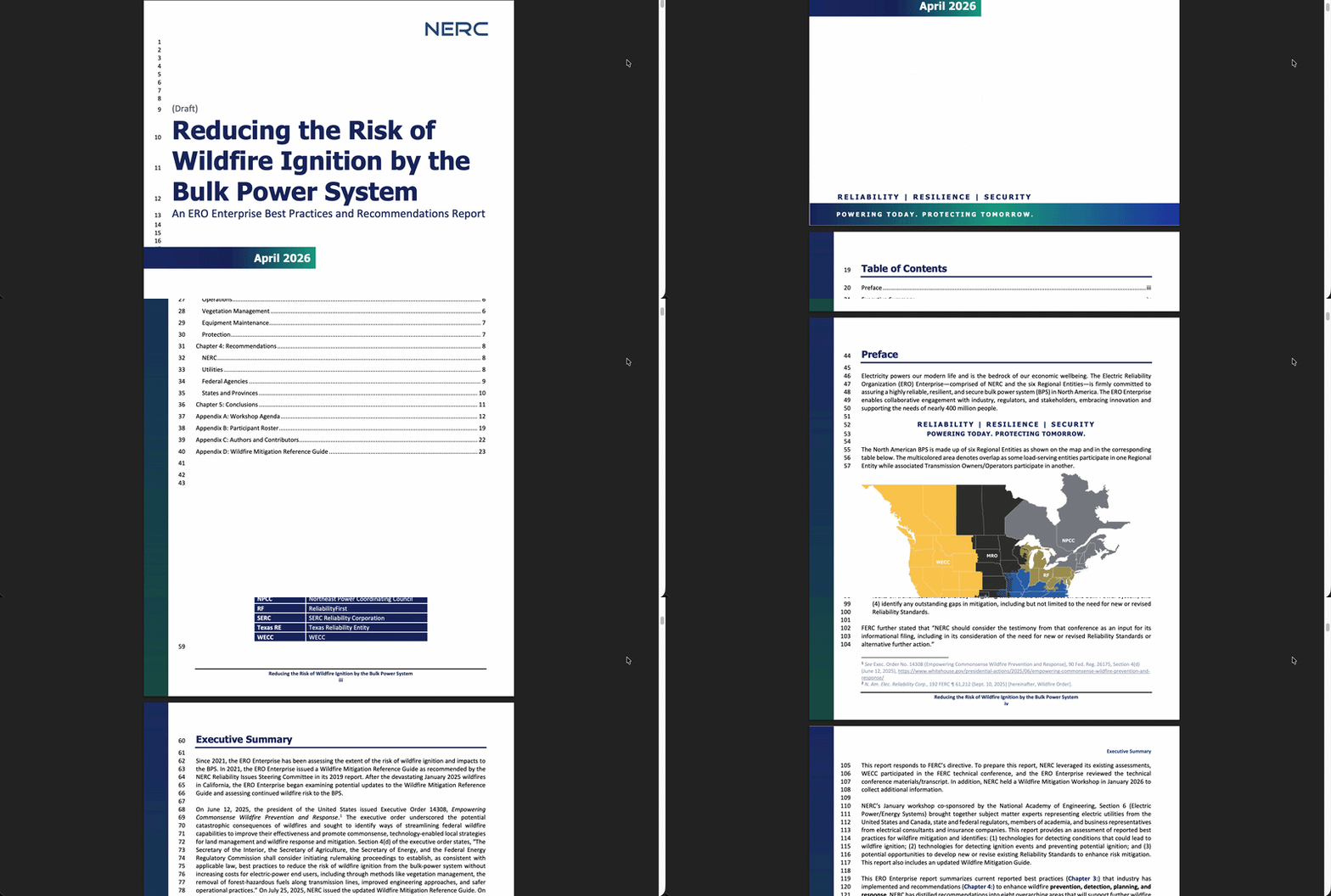
NERC’s April 2026 draft report, Reducing the Risk of Wildfire Ignition by the Bulk Power System, is an informational filing being prepared for submission to the Federal Energy Regulatory Commission (FERC) by May 1, 2026.
Rather than creating new rules itself, the report outlines current best practices, identifies gaps in existing reliability standards, and recommends where regulatory changes may be needed next, particularly in vegetation management, grid operations, equipment maintenance, protection settings, and wildfire risk monitoring.
Specifically, it includes:
- an updated Wildfire Mitigation Reference Guide
- an assessment of current industry best practices across operations, vegetation management, equipment maintenance, and protection systems
- formal recommendations for NERC, utilities, federal agencies, and state or provincial regulators
- an overview of gaps in existing reliability standards
While the report is not itself a regulation, it is clearly intended to inform future rulemaking and shape upcoming regulatory changes.
Why Is This Report Being Produced?
The report is the result of a clear chain of regulatory events:
January 2025 — The Los Angeles wildfires cause catastrophic destruction, reigniting federal focus on grid-caused ignition risk.
June 12, 2025 — President Trump signs Executive Order 14308, directing FERC, the Department of Energy, USDA, and the Department of the Interior to identify best practices for reducing wildfire ignition risk from the bulk power system — without increasing costs for end users.
September 10, 2025 — FERC issues a formal order directing NERC, as the Commission-certified Electric Reliability Organization (ERO), to produce this report by May 1, 2026 — specifically timed to be available before the next fire season. FERC simultaneously convenes a technical conference (held October 21, 2025) to gather expert input.
January 29–30, 2026 — NERC holds a two-day Wildfire Mitigation Workshop in partnership with the National Academy of Engineering, bringing together utility executives, academics, state regulators, and insurance companies. The workshop findings feed directly into this draft.
What Are the Key Changes Proposed?
1. Expanding FAC-003 — The Big Shift
The current FAC-003 Transmission Vegetation Management standard applies only to transmission facilities rated 200 kV and above.
NERC recommends modifying Reliability Standard FAC-003 to apply to additional transmission facilities in order to reduce the likelihood of wildfire ignition by the Bulk Power System.
The report’s primary regulatory recommendation is to extend the standard to cover facilities rated 100 kV and above as part of ongoing efforts to address wildfire risks through reliability standards.
This is significant. The 100–199 kV tier accounts for 43.5% of all wildfire-impacted transmission events and, as noted above, 86% of vegetation-contact outages. Bringing these lines under mandatory vegetation management rules would represent the largest expansion of FAC-003's scope since the standard was created.
2. A Standards Gap Review
NERC is asked to review multiple existing standards for wildfire-related gaps, specifically:
- Prevention: FAC-003, FAC-501, PRC-027, PRC-004
- Planning: TPL-001, TPL-008-1
- Detection & Response: IRO-010, EOP-011
The review process will provide valuable insights and details about incidents that have influenced the development of wildfire-related reliability standards.
3. Operational Best Practices (Voluntary Today, Potentially Mandatory Tomorrow)
The report identifies a set of operational practices that high-performing utilities are already using, and which could form the basis of future standards. Key among them:
- Disable automatic reclosing on transmission lines in High Fire Risk Areas (HFRAs) during elevated fire weather conditions
- No re-energization of tripped lines in HFRAs until patrol is complete and authorization received
- 72-hour advance PSPS assessments using wind speed, Fire Potential Index (FPI), and on-site meteorologists
- Vegetation removal at least twice per year in defined HFRAs, with zero-clearance zones maintained around towers and substations (one utility found 84% of transmission ignitions propagated from within the 50-foot zone under transmission structures)
- Relay sensitivity settings that adapt to fire weather conditions
To ensure these best practices are implemented effectively, operator training is essential so that personnel are qualified and proficient in both routine and emergency operations. Ongoing coordination and collaboration among utilities, regulators, and other stakeholders is also necessary to support consistent implementation and maintain operational reliability and grid security.
4. Technology Adoption
The report endorses a wide range of technologies as best practice for wildfire risk detection and prevention:
- LiDAR, satellite imagery, and drone-based inspections
- AI/machine learning for vegetation proximity modeling and risk forecasting
- Dynamic line rating sensors
- High-definition camera networks and weather station arrays
- Infrared inspections to identify equipment hot spots
5. Industry Organization
NERC recommends utilities consider forming a dedicated wildfire risk organization modeled on the Institute of Nuclear Power Operations (INPO) — including peer reviews, near-miss data collection, and insurance incentives tied to practice adoption.
Collaboration among members and stakeholders is essential in such organizations, as it enables the sharing of best practices and coordinated efforts to improve wildfire mitigation strategies.
What Does This Mean for Utilities?
More Lines to Monitor — A Lot More
The proposed expansion of FAC-003 to 100 kV+ is not a marginal change.
Utilities that currently only apply rigorous vegetation management programs to their highest-voltage lines would need to extend those programs to a much larger portion of their network, in some cases, doubling or tripling the circuit miles under formal management.
This means:
- More frequent inspections across a broader asset base, requiring scalable tools rather than manual processes. Utilities will need to ensure they have sufficient resources to maintain adequacy and reliability as monitoring requirements expand.
- Expanded data collection on vegetation proximity, growth rates, and encroachment risk for lines previously outside mandatory scope.
- Risk-based prioritization. The report calls for asset management systems capable of tracking equipment to the individual component level, including location, installation date, type, and manufacturer.
The Software and Monitoring Gap
For many utilities, the practical bottleneck isn't willingness, it's capacity. Manually patrolling hundreds of additional circuit miles is neither fast enough nor cost-effective enough to meet the risk profile the report describes.
This is exactly the problem that remote sensing and AI-powered vegetation intelligence platforms are designed to solve. These AI-powered platforms enhance the ability of utilities to monitor for incidents that could affect grid reliability, enabling real-time detection and response to threats that may compromise system stability.
Tools like LiveEO's Treeline, which uses satellite imagery and machine learning to continuously monitor vegetation risk, including hazard trees, along transmission corridors, become operationally essential when the scope of mandatory monitoring expands significantly.
Rather than infrequent ground patrols, utilities can maintain continuous awareness of encroachment risk across their entire network, prioritize field crews based on data-driven risk scores, and document compliance with the kind of granularity that regulators increasingly expect.
The report's endorsement of AI-assisted geospatial tools for vegetation proximity modeling, trend analysis, and proactive risk identification aligns directly with this capability.

Insurance Implications
Notably, the report explicitly links wildfire mitigation practice adoption to insurance costs.
NERC recommends that an industry organization provide insurance rate incentives tied to the maturity of a utility's wildfire mitigation practices, and FERC has been asked to explore pooled risk-based insurance premiums for utilities based on performance.
Utilities that invest in advanced monitoring now are likely to be better positioned on both regulatory compliance and insurance costs as these mechanisms develop.
Canadian Utilities Are in Scope
The report and its recommendations apply across North America. Canadian utilities, particularly those in British Columbia and Alberta, which have experienced significant wildfire events, are explicitly included in the cross-jurisdictional coordination framework.
Download the NERC Wildfire Draft Report
Want to explore the source document in full? Click here to download the April 2026 draft of NERC’s Reducing the Risk of Wildfire Ignition by the Bulk Power System to review the proposed FAC-003 expansion, recommended utility practices, and the broader regulatory direction ahead of FERC’s May 1, 2026 filing deadline.
Timeline: What Has Happened, and What Comes Next
So Far
What Comes Next
After May 1, 2026 — FERC review and response. FERC will review the informational filing and respond to the proposed recommendations. It may issue an order directing NERC to begin a formal standards development process, or issue a Notice of Proposed Rulemaking (NOPR) if it chooses to act directly. FERC may also require the development of new or revised mandatory reliability standards, which, once approved, become legally enforceable to help ensure the reliability and security of the electric grid.
FAC-003 Standards Development Project. If FERC directs NERC to modify FAC-003, NERC must convene a standards drafting team, open public comment periods, and submit a ballot to its registered stakeholders. This process typically takes 18–36 months from initiation to FERC approval.
FERC Approval. Once NERC submits a revised standard, FERC must approve it — a process that can add another 6–12 months, including additional comment periods.
Realistic timeline for FAC-003 expansion becoming enforceable regulation: 2028 at the earliest, more likely 2029.
However, utilities should not wait. The report makes clear that the practices it describes, expanded vegetation management, AI-assisted monitoring, adaptive protection settings, are being adopted by leading utilities now, and will inform how regulators assess performance in the interim period. The direction of travel is unambiguous.
What Should Utilities Do Now?
- Audit your 100–199 kV exposure. Identify your lines in this voltage range and assess the gap between your current vegetation management programs and what FAC-003 would require if extended to this tier.
- Invest in scalable monitoring. Ground patrol alone will not be sufficient at the scale the new rules would require. Evaluate remote sensing and AI vegetation intelligence platforms that can provide continuous, auditable coverage across your network.
- Develop or update your Wildfire Mitigation Plan. Even outside California, the report signals that WMPs will increasingly be expected of utilities in fire-prone areas across the continent.
- Engage in the standards process. NERC's standards development process is open to stakeholder participation. Utilities that engage early have the opportunity to shape how the new requirements are written.
- Align with insurance requirements proactively. As risk-based insurance frameworks develop, documented practice maturity will matter. Start building that record now.
The NERC draft report is available on the NERC website. The final version is expected to be filed with FERC on or before May 1, 2026, in Docket Nos. RD25-9-000 and AD25-16-000.
The NERC Wildfire Report Explained on The Utility Vegetation Management Podcast
The report is also discussed in Episode 40 of The Utility Vegetation Management Podcast, where hosts Nick Ferguson and Stephen Cieslewicz speak with Jim Kubrak, Senior Technical Advisor at NERC and a key author of the draft.
The episode explores why wildfire risk is increasingly being treated as a bulk power reliability issue, what is driving the push to expand FAC-003 to 100 kV lines, and how utilities may need to adapt vegetation management, wildfire mitigation planning, and monitoring practices as standards development moves forward.
Listen to the episode here: 40 | NERC: Executive Order 14308, Empowering Commonsense Wildfire Prevention and Response
FAQ
What is the main takeaway from the NERC wildfire report?
The report signals that utilities should prepare for stricter wildfire mitigation expectations, especially around vegetation management, operational practices, and technology adoption in fire-prone areas. Its most important recommendation is to expand FAC-003 so that it applies to transmission facilities rated 100 kV and above.
Why is the proposed FAC-003 expansion significant?
It would extend mandatory vegetation management requirements to a much larger share of the grid. That matters because transmission lines rated 100 to 199 kV account for a large share of wildfire-impacted transmission events and vegetation-contact outages.
Is the NERC wildfire report itself legally binding?
No. The report is an informational filing prepared for FERC, not a regulation. However, it is clearly intended to inform future regulatory action and could lead to new or revised mandatory reliability standards.
What technologies does the report highlight for wildfire risk reduction?
The report points to LiDAR, satellite imagery, drone inspections, AI and machine learning for vegetation proximity modeling, dynamic line rating sensors, high-definition cameras, weather station arrays, and infrared inspections to identify equipment hot spots.
What should utilities do now?
Utilities should assess their exposure on 100–199 kV lines, invest in scalable monitoring tools, update wildfire mitigation plans, engage in the standards development process, and prepare for tighter vegetation management and operational expectations.
What other initiatives has NERC worked on beyond wildfire mitigation?
Beyond its wildfire-related reliability work, NERC also has a broader track record of cybersecurity collaboration across the electric sector. Through the Electricity Sector Information Sharing and Analysis Center (E-ISAC) and its Cybersecurity Risk Information Sharing Program (CRISP), NERC works with utilities, critical asset owners, government agencies, and industry partners to share threat intelligence, analyze real-time security data, and strengthen the grid’s resilience against cyber threats. That history of coordination provides useful context as utilities adopt more connected technologies for wildfire monitoring, detection, and system operations.