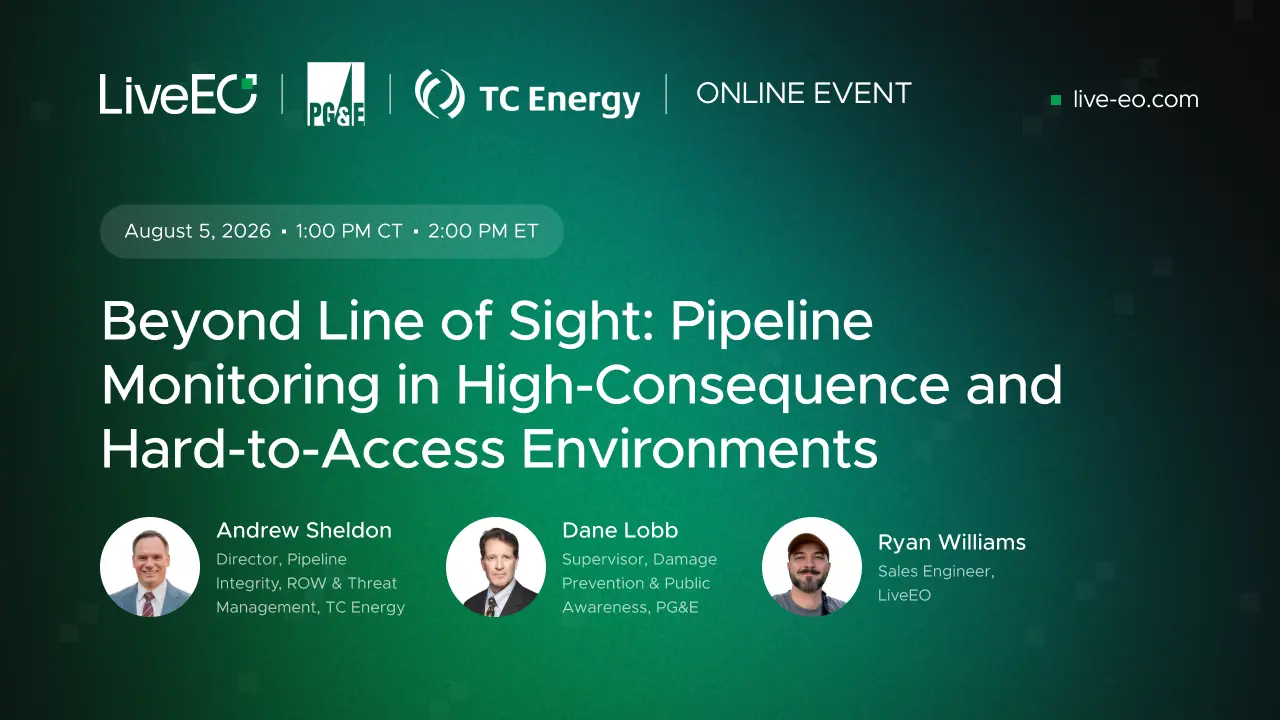

Pipeline monitoring programmes are built around the assumption that the corridor can be observed. But for many operators, large portions of their network sit in environments where that assumption breaks down.
High-consequence areas in densely populated corridors. Remote or rugged terrain that ground patrols cannot reliably reach. Restricted airspace that limits or eliminates conventional aerial surveillance. Each of these constraints creates the same fundamental problem: sections of the pipeline that cannot be consistently monitored, regardless of how much effort is applied.
Where monitoring gaps persist, so do the risks. Damage prevention programmes lose effectiveness. Safety assurance becomes harder to sustain. Regulatory obligations that assume continuous oversight become more difficult to meet.
To explore how operators manage these challenges in practice, we are hosting a live virtual session with representatives from TC Energy and Pacific Gas and Electric Company (PG&E), two of North America’s largest pipeline operators.
{{button}}
Operating Under Constraint: Real-World Experience from TC Energy and PG&E
TC Energy manages an extensive pipeline network spanning the United States and Canada, including infrastructure crossing some of the most operationally complex environments on the continent. PG&E operates critical gas infrastructure across California, including corridors that run through densely populated urban areas and remote terrain alike.
Both operators face the challenge of maintaining meaningful oversight in sections of corridor where conventional monitoring approaches, helicopter patrols, routine ground inspection, aerial surveillance, face real limitations. The constraints are different. The implications are similar: blind spots that cannot be resolved simply by scheduling another flight or deploying another crew.
This session will draw on direct operational experience from both organisations, covering the realities of monitoring pipelines in environments that challenge standard approaches, and what operators have done to maintain safety and integrity in spite of those constraints.
What the Webinar Will Cover
This session will provide a practical, operator-led perspective on maintaining pipeline safety and operational confidence where access is limited, regulated, or unreliable.
Key topics include:
- The operational reality of monitoring pipelines in densely populated, remote, restricted, and hard-to-access areas
- The safety, integrity, and compliance risks created by monitoring blind spots
- How physical and regulatory constraints reduce the effectiveness of traditional pipeline inspection and damage prevention programmes
- Practical approaches operators are taking to maintain visibility and confidence in challenging environments
- Lessons learned and emerging best practices from field experience at TC Energy and PG&E
The discussion will draw directly on the operational experience of both speakers, not hypothetical scenarios.
{{button}}
Meet the Speakers
Andrew Sheldon
Director, Pipeline Integrity, ROW & Threat Management, TC Energy
Andrew Sheldon is Director of Pipeline Integrity, ROW & Threat Management at TC Energy, where he leads programmes focused on pipeline safety, integrity, and operational risk across the U.S. With more than a decade of engineering and leadership experience in the energy sector, he has built a strong track record in corrosion management, engineering execution, and large-scale project delivery. Andrew combines deep technical expertise with strategic leadership, drawing on a Ph.D. in Aerospace Engineering, an MBA from Tulane University, and his experience driving innovation, efficiency, and team development in complex pipeline operations.
Dane Lobb
Supervisor, Damage Prevention & Public Awareness, PG&E
Dane Lobb is a public safety and utility infrastructure leader with over two decades of experience spanning law enforcement and the energy sector. He currently serves as Supervisor of Damage Prevention and Public Awareness at Pacific Gas and Electric Company, where he leads efforts to protect critical infrastructure and educate the public on pipeline and utility safety. A former Lieutenant with the California Highway Patrol, Dane also chairs the Board of the American Red Cross Central California Region.
Ryan Williams
Sales Engineer, LiveEO (Moderator)
{{button}}
Who Should Attend
This session is designed for professionals involved in:
- Pipeline integrity and risk management
- Right-of-way monitoring and damage prevention
- Operations and field response
- Regulatory compliance and safety programmes
- Land management and corridor access
Anyone responsible for maintaining pipeline oversight in environments where conventional monitoring methods face physical or regulatory limitations will benefit from this discussion.
Save Your Spot Today
As access constraints, regulatory restrictions, and population density along pipeline corridors continue to evolve, the ability to maintain safety assurance across the full network has never been more important.
This session will provide a practical, experience-based perspective on how to manage surveillance gaps, sustain operational confidence, and meet compliance obligations in environments that push traditional monitoring to its limits.
Date: Wednesday, August 5, 2026 at 1:00PM CT / 2:00PM ET
Register now to secure your place and hear directly from TC Energy and PG&E on how they approach pipeline monitoring in high-consequence and hard-to-access environments.